
Root Cause Analysis
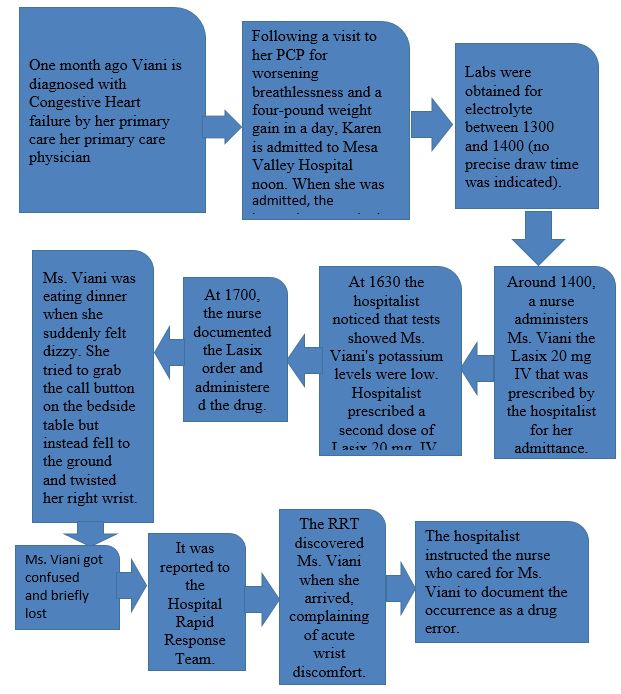
This root cause analysis and patient safety initiatives are focused on the incident at Mesa Valley Hospital when Karen Viani, a seventy-six-year-old client with congestive heart failure (CHF), slipped out of bed while struggling to reach the call bell on the table next to her. Ms. Viani fractured her wrist and sustained a cut to her forehead as a result of the incident. A flowchart is one tool that can be used to help explain who, what, when, and why the incident occurred. The timeline that I have presented below shows the events from Ms. Viani’s preliminary CHF diagnosis a month earlier to her falling out of a hospital bed at Mesa Valley Hospital.
Timeline
Factors
The first contributing factor is that Ms. Viani’s fall was caused by the delayed administration of Lasix and the subsequent depletion of potassium levels. The nurse might not have administered Lasix as directed due to a heavier workload caused by staffing concerns. The hospitalist recommended a second dose of Lasix after seeing low potassium levels in Ms. Viani’s lab results. However, this would have been avoided if the nurse had informed the doctor of the delayed administration and lab results before the first dose.
The second contributing factor is the absence of patient safety precautions to prevent patient dropping, which is another issue that caused Ms. Viani’s fall. Ms. Karen dropped out of bed as a result of nurses’ neglect to take into account the patient as having a fall risk due to the drugs (Lee et al., 2019). Notifying the patient of the danger, activating a bed alarm, and putting the emergency light in a position where the patient can easily reach it (Lee et al., 2021).
If the bed railings had been raised and the alarm clock had been placed in the patient’s grasp. Viani could have been grasping over the edge of the bed, may not have collapsed, and may not have suffered injuries to her head and wrist. It may have been due to a weak safety culture that the bed rails were not raised, and the call bell was not closed. One causal factor of Ms. Viani’s fall and subsequent harm was her untreated low potassium levels while taking medicine that continued to lower her potassium levels, leaving her dizzy and prone to falls.
Patient Safety Strategies and Recommendations
The main issues that threatened the well-being of patients and resulted in patient injury were a lack of effective collaboration and an inappropriate safety culture, such as failing to apply fall measures. Patient safety is a health profession that attempts to prevent and decrease hazards, mistakes, and harm to patients throughout health care, according to the World Health Organization (World Health Organization, 2021). Furthermore, according to the World Health Organization (WHO), “providing quality, critical patient care” depends on having effective patient safety policies.
Before Ms. Karen Viani lost consciousness, fell out of bed, and hurt herself, there were numerous chances to increase patient safety in her situation. For instance, if the nurse had informed her supervisor that more personnel were needed to ensure she was not too busy to administer medication on time. Therefore, Ms. Viani may not have received the first IV Lasix dose 3 hours later. Ms. Viani could have raised the alarm when her IV Lasix failed to arrive right after admission, as she was not given the IV Lasix dose.
Potentially leading to a delay during the lab draw, if the client had been informed of the medications, examinations, and medications she was going to get, and when they were going to be administered. The Quick Safety SPEAKUP Program, developed by the Joint Commission for Patient Safety, is a healthcare safety method to prevent problems like this in future instances (Lee et al., 2019). This safety program promotes efficient teamwork, maintains sufficient staffing levels, and fosters patient involvement in their care to assist in reducing delays in therapy and healthcare mistakes brought on by inadequate communication.
Implementing a straightforward strategy that required an initial electrolyte panel before providing diuretics for managing congestive heart failure could have eliminated the accidental factor of low potassium in Ms. Viani’s collapse. Any patient taking fall-risk-increasing drugs, such as diuretics, should have fall prevention measures in place, such as teaching the patient and their loved ones about the risks of falls due to adverse reactions to medications. Other fall prevention measures include keeping the bed rails up, bedside alarms enabled, and calling lights readily accessible. The patient’s and their household’s responsibility is to participate in their medical care actively, speak up for themselves, and be informed about any potential prescription side effects. To avoid negative effects, concerns expressed by the patient or close relatives regarding medication use ought to be considered.
Measurements
Patient safety questionnaires and hospital data, including patient complaints, staffing reports, and patient opinion surveys, can be used to evaluate how well patient safety policies are working. However, staffing and safety culture had low favorable response rates at Mesa Valley Hospital despite having excellent scores in learning organizationally, continuous development, and teamwork. A decrease in patient events brought on by treatment delays, improved satisfaction among patients and staff, and decreased staffing shortages should all result from implementing tactics like the Quick Safety SPEAKUP program (Joint Commission, 2018). According to hospital statistics, evaluating patient incident reports of patient falls, which are used to assess the efficacy of fall risk control methods, reveals a decrease in patient falls from the prior year in Mesa Valley.
References
Joint Commission. (2018). Facts about speaking up. Web.
Lee, J., Negm, A., Peters, R., Wong, E. K. C., & Holbrook, A. (2021). Deprescribing fall-risk increasing drugs (FRIDs) for the prevention of falls and fall-related complications: a systematic review and meta-analysis. BMJ Open, 11(2), 1–14. Web.
Lee, S. E., Scott, L. D., Dahinten, V. S., Vincent, C., Lopez, K. D., & Park, C. G. (2019). Safety Culture, Patient Safety, and Quality of Care Outcomes: A Literature Review. Western Journal of Nursing Research, 41(2), 1–26. Web.
World Health Organization. (2021). Falls. World Health Organization. Web.